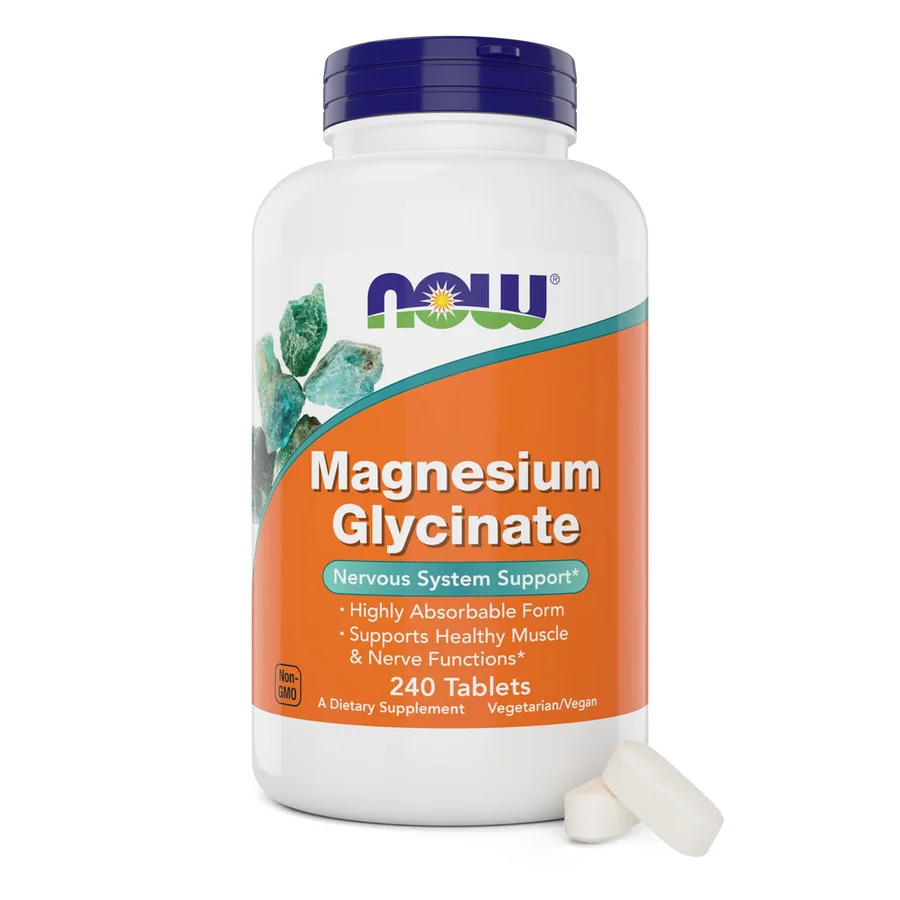
Official product photography, NOW Foods / NOW Health Group.
NOW Foods Magnesium Glycinate Tablets
Magnesium is a mineral your cells use as a required helper for hundreds of enzyme reactions, from energy production to nerve signaling to muscle relaxation. NOW Foods' Magnesium Glycinate Tablets are one of the more widely purchased magnesium supplements on Amazon — a chelated, glycine-bound form from a long-established U.S. manufacturer. Below is what the underlying biology actually says, what's genuinely certified on this label versus simply implied, and what to know before starting it.
As an Amazon Associate, Modern Biology News earns from qualifying purchases. Price and tablet count vary by pack size — see the Amazon listing for current details.
What magnesium actually does inside a cell
Magnesium is the fourth-most abundant mineral in the human body, and most of it isn't floating in the bloodstream — about 50% to 60% is stored in bone, with most of the rest inside muscle and other soft tissue. Functionally, magnesium's main job is acting as a required cofactor: a helper ion that has to be physically present for a very large number of enzymes to work correctly. The NIH Office of Dietary Supplements puts the number at more than 300 enzyme systems, spanning energy metabolism, protein synthesis, and DNA and RNA production. One especially foundational example: ATP, the molecule cells use as their basic energy currency, normally exists inside cells bound to a magnesium ion (as Mg-ATP) — magnesium isn't a side character in cellular energy production, it's part of the working molecule itself.
Magnesium also plays a direct, well-established role in moving calcium and potassium ions across cell membranes, a process that underlies nerve impulse conduction, muscle contraction, and normal heart rhythm. None of this is a disputed or emerging idea — it's standard mineral physiology, taught the same way in any biochemistry textbook.
Magnesium and calcium generally work as physiological counterparts inside muscle cells: calcium entering a muscle cell triggers contraction, and magnesium helps the cell relax afterward, partly by competing with calcium for shared binding sites and supporting calcium's return to storage inside the cell. This is one reason magnesium is discussed alongside muscle function specifically, rather than being a generic "energy mineral" claim.
Magnesium and nerve signaling
Magnesium has a specific, well-characterized role at a receptor called the NMDA receptor, a gate in nerve cell membranes that opens in response to the neurotransmitter glutamate. At a nerve cell's normal resting state, a magnesium ion sits inside that channel and physically blocks it, holding the gate effectively closed until the cell is sufficiently activated to displace the magnesium ion. This voltage-dependent magnesium block, first described in the neuroscience literature in the 1980s, is one of the basic mechanisms that keeps excitatory nerve signaling in check rather than firing unchecked. It's a real, foundational piece of cellular neurophysiology — not a marketing simplification.
Separately, because typical U.S. dietary intake of magnesium often runs below recommended levels (a documented pattern in national nutrition survey data, distinct from a diagnosed deficiency), the NIH Office of Dietary Supplements notes that a healthy kidney is what normally keeps blood magnesium levels stable regardless of intake — meaningful, sustained deficiency in someone with normal kidney function is comparatively uncommon, even when dietary intake runs a bit low.
What "glycinate" means, and why a chelated form exists
"Magnesium glycinate" (also called magnesium bisglycinate) refers to elemental magnesium bound to two molecules of glycine, an amino acid, rather than to a simple salt like an oxide, sulfate, or chloride. Binding a mineral to an amino acid this way is called chelation, and NOW Foods specifically uses the Albion TRAACS chelation process, a patented, industry-standard method for producing amino-acid-chelated minerals. The practical rationale manufacturers give for glycinate specifically is gastrointestinal tolerability: cheaper magnesium salts such as magnesium oxide are poorly absorbed and pull water into the intestine by osmosis, which is why they're more likely to cause loose stools at meaningful doses. Glycinate is marketed as gentler on the digestive system at comparable doses. That rationale is grounded in real, plausible chemistry, but head-to-head clinical comparisons of absorption and tolerability between chelated glycinate and other magnesium forms in healthy adults are more limited than the marketing volume around this ingredient would suggest — worth knowing rather than assuming settled.
Glycine itself is also a known inhibitory neurotransmitter in the spinal cord and brainstem, and a co-agonist at the same NMDA receptor magnesium blocks. Some people specifically seek out the glycinate form for that additional biological property. That mechanism is real at the cell-biology level, but it is a separate, thinner evidence base from magnesium's own well-established cofactor role, and we're not presenting it as a settled clinical outcome.
Certifications: what's real, and what isn't being claimed
We want to be precise here rather than let one kind of quality claim stand in for another, because they aren't interchangeable.
| What's real | NOW Foods is a family-owned manufacturer operating since 1968 out of Bloomingdale, Illinois, and holds an "A" rating from the Natural Products Association (NPA) under that organization's Good Manufacturing Practices (GMP) certification program — an audited, facility-level quality-systems credential, re-certified annually. This specific product's label also carries Non-GMO Project Verified and Kosher certification, and is labeled vegetarian/vegan. |
|---|---|
| What we did not find | A product-specific, batch-level potency or purity seal — the kind issued by an independent lab that tests the actual finished tablets, such as NSF Certified for Sport or USP Verified. We did not find either mark on this product's packaging or on the retailer listings we checked. That's a narrower, different claim than the facility-level GMP rating above; it's common for mainstream mid-market supplements generally, not a defect unique to this product, but it's a real, checkable gap worth naming. |
On the label
| Serving size | 2 tablets |
|---|---|
| Magnesium (elemental) | 200 mg per serving (48% Daily Value), supplied as 2,000 mg Magnesium Bisglycinate Chelate (Albion TRAACS) |
| Other ingredients | Citric acid, hydroxypropyl cellulose, stearic acid (vegetable source), silicon dioxide; vegetarian coating (hypromellose, stearic acid, sunflower lecithin, triethyl citrate, sunflower oil) |
| Suggested use | 2 tablets, 1 to 2 times daily, with food |
| Allergen note | Manufactured without wheat, gluten, soy, milk, egg, fish, shellfish, tree nut, or sesame as added ingredients — always check the specific bottle and lot, since formulations can change. |
One detail worth flagging plainly: the labeled 200 mg elemental-magnesium dose is per two-tablet serving, not per tablet. Someone skimming the front label and taking one tablet a day would be getting roughly half the dose stated on the panel — a common point of confusion across magnesium products generally, not unique to this one, but easy to miss.
Who should talk to a doctor before starting this
Magnesium is generally well tolerated, but it has real, documented cautions worth knowing. Because the kidneys are what clear excess magnesium from the body, anyone with impaired kidney function has a meaningfully higher risk of magnesium building up to unsafe levels and should not start a magnesium supplement without medical guidance. Magnesium can also reduce the absorption of certain antibiotics (including tetracyclines and quinolones) and bisphosphonate osteoporosis medications when taken too close together — the standard guidance is to separate dosing by several hours, on a doctor's or pharmacist's specific direction. At high enough doses, supplemental magnesium (even the more tolerable glycinate form) can still cause diarrhea, nausea, or abdominal cramping. Anyone pregnant, nursing, or managing a diagnosed medical condition on other medication should check with a healthcare provider before adding this or any new supplement, rather than treating it as a formality to skip.
What's genuinely solid here
- Clearly disclosed elemental-magnesium dose (200 mg per 2-tablet serving) rather than a vague proprietary blend
- Real chelation technology (Albion TRAACS) with a plausible, well-documented tolerability rationale
- Non-GMO Project Verified and Kosher on this specific label, plus vegetarian/vegan formulation
- Established, traceable manufacturer (NOW Foods, since 1968) with NPA A-rated GMP facility certification
What to keep in perspective
- No product-specific batch potency certification (NSF Certified for Sport / USP Verified) found on this item
- Full labeled dose requires 2 tablets, not 1 — easy to under-dose by mistake
- Real interactions with certain antibiotics and bisphosphonates, and a genuine caution for anyone with impaired kidney function
- Glycinate's extra "calming" reputation (via glycine) rests on a thinner evidence base than magnesium's own core cofactor science
As a manufacturing bet, this is a straightforward, clearly labeled version of a genuine, well-studied mineral, from an established manufacturer with a real facility-level GMP credential — though it lacks an independent, product-specific potency seal, which is worth knowing rather than assuming. As a biological bet, magnesium's core roles in enzyme function, nerve signaling, and muscle relaxation are settled, mainstream physiology, not a stretch claim; the glycinate form's added tolerability rationale is plausible chemistry, and its extra reputation via glycine is a real but thinner, secondary consideration. Take the full 2-tablet serving to hit the labeled dose, and check with a doctor first if you have kidney impairment or take an antibiotic, bisphosphonate, or other medication that could interact.
This article is for general educational purposes and is not intended to diagnose, treat, cure, or prevent any condition. It is not medical advice. Talk to a healthcare provider before starting any new supplement, especially if you take prescription medication or have a kidney condition.
NIH Office of Dietary Supplements — Magnesium: Fact Sheet for Health Professionals.
Mayer ML, Westbrook GL, Guthrie PB. "Voltage-dependent block by Mg2+ of NMDA responses in spinal cord neurones." Nature, 1984 — foundational description of magnesium's NMDA-receptor block.
Albion Minerals (Balchem) — TRAACS (The Real Amino Acid Chelate System) chelated-mineral technology documentation.
NOW Foods (nowfoods.com) — Magnesium Glycinate Tablets product labeling and Seals & Certifications pages, on the company's NPA GMP "A" rating, Non-GMO Project Verified, and Kosher certification.
Amazon.com product listing — "Now Foods Magnesium Glycinate, 240 Tablets" (ASIN B0CB984SHQ), Supplement Facts panel and product images.
Federal Trade Commission — Guides Concerning the Use of Endorsements and Testimonials in Advertising (16 CFR Part 255), applicable to the affiliate link above. See our Affiliate Disclosure.